
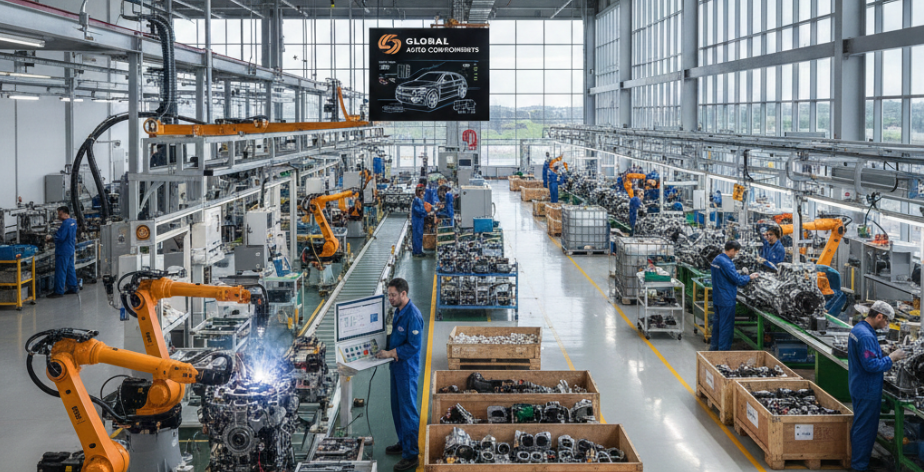
The automotive sector is experiencing a substantial change, and automation is the main factor driving this transformation. The majority of the auto parts manufacturers are already using modern technologies in their production processes in order to cope with the increased customer expectations, the need for quicker production cycles, and the need for more accurate products. Automation is taking over the entire process from design through production and delivery of the components. Robotics is already being used everywhere, and AI is even aiding in quality inspection. This change not only enhances effectiveness and efficiency but also allows manufacturers to remain competitive on a global scale. The automation of producing high-quality and reliable automotive parts at huge volumes is the very thing that is shaping the future of auto component manufacturing,g as modern plants are turned into smart factories.
Why Automation Matters for Every Auto Part Manufacturer Today
Automation is not just a choice any longer; it is a requirement for every auto part manufacturer that is part of a competitive global automotive ecosystem. Automation is making the manufacturers remain efficient and also future-ready amidst demand for precision components, quicker turnaround times, and lower production costs.
Main advantages:
- Increases output by eliminating human errors
- Lowers the costs of operation by streamlining the processes
- Increases the uniformity and accuracy of parts
- Guarantees qa uick reaction to the demand of the market
- Enhances the global competitiveness of every auto part manufacturer
From Manual to Automated: The Evolution of Auto Part Manufacturing
The auto part maker has suffered a vital change in its production process over the years, moving from time-consuming methods to the fusion of advanced technologies. Mechanization at the beginning of the process has now evolved into a fully automated, digitally connected production system that is operated by robots and data analytics.
Milestones of evolution:
- Change from manual machining to semi-automated lines
- Usage of CNCs for better precision
- Extensive use of robots for welding, assembly, and handling
- Connection of AI, IoT, and smart sensors
- Appearance of Industry 4.0 and smart manufacturing models
Role of Robotics in Auto Component Production
With robotics, every contemporary auto parts manufacturer can rely on it as a basic pillar, thus bringing about quickness, precision, and a high degree of dependability in production. Through the use of robotic systems, safety and uniformity are guaranteed in areas where both repetitive and complex operations take place.
Applications of robotics include:
- Automatic welding and joining processes
- Exact assembly of minute parts
- Use of industrial robots for paint and varnish Handling of materials and wrapping
- CCobot-typerobots coexist with workers and boost their output
Advanced CNC Machining and Smart Tooling
The use of CNC machining has transformed the process of creating high-precision automotive parts for an auto parts manufacturer. The use of smart tooling and automated machining has made it possible to cut down on material waste significantly because of the improved accuracy, and obtain the most complex shapes that the manual method can’t produce.
The main benefits of CNC are:
- Micron-level precision for critical components
- Automated tool calibration and wear detection
- Reduced cycle times for mass production
- Ability to handle complex and lightweight materials
- Predictive maintenance for longer machine life
Additional Manufacturing (3D Printing) in Automotive Parts
The innovative automobile parts maker has recognized the potential of 3D printing in a number of applications, such as prototyping, customization, and designing of light components. Additive manufacturing is the key to quicker development cycles and more economical production of low-volume parts.
3D printing advantages are as follows:
- Quick prototyping for the purpose of assessing designs
- Strong but light parts that boost the efficiency of fuel
- Less material waste when compared with conventional techniques
- Manufacturing of complex shapes without any extra cost
- Shortened workflow from design to production.
Automation in Quality Control & Inspection
Contemporary auto parts manufacturers place great dependence on automatic quality control systems to keep their product standards perfect. Human error is significantly decreased through the use of machine vision, AI evaluation, and laser scanning, and constant accuracy is guaranteed.
QC automation pros:
- Very precise automated defect detection
- Instant inspection and data collection
- Better meeting of international automotive standards
- Quicker processes for rejection and correction
- Greater visibility across manufacturing lines
Data-Managed Manufacturing With IoT & Digital Twins
The Internet of Things (IoT), along with digital twins are changing the way an auto parts manufacturer is monitoring, predicting, and optimizing the performance of its production. These innovations make it possible to make decisions based on data by creating a digital twin of the physical systems.
Main features:
- Monitoring of machines and alerts simultaneously
- Maintenance done before failure to cut down on time lost due to non-functioning machines
- Testing through simulation with digital twins
- Planning workflows in the most efficient way
- Integration of data without hassle at different production stages
Smart Supply Chain Automation for Auto Part Manufacturers
A seamless supply chain is a necessity for any automobile parts maker, and with automation, the whole process from buying to delivery is hassle-free. Automated systems bring about greater visibility, cut down delays, and accelerate the whole logistics process.
Advantages of automating the supply chain:
- Monitoring and predicting inventory levels automatically
- Robots in the storeroom for quick sorting of items
- Management of suppliers and orders using AI
- Quicker delivery with tracking in real-time
- Lower costs due to the efficient movement of materials
Sustainable & Energy-Efficient Automated Production
Sustainability is no longer a fancy term; it has become a business necessity, and automation has made it possible for an auto part manufacturer to lessen their environmental impact and, at the same time, be more efficient. The behaviour of smart machines is so adjusted that the energy needed is as little as possible, and waste just about does not happen.
Advantages of sustainability:
- Intelligent machines use significantly less energy.
- Materials are used exactly, and waste is therefore turned into nothing.
- Processes are cleaner, and hence, the carbon footprint is lowered.
- Scrap materials are recycled efficiently
- Global environmental standards are easily complied with.
Customization & Flexible Manufacturing Systems
The automobile models have been increasing in diversity, which means that the auto part manufacturer needs to be very quick in adapting. Alteration is made easier through flexible manufacturing systems. This also facilitates quicker changeovers.
Advantages of flexibility:
- Fast retooling for various component designs
- Assistance in the production of small-batch, custom, or variants
- Automation of scheduling and workflow adaptation
- Improved management of various materials and shapes
- Greater OEM requirement responsiveness
Challenges Auto Part Manufacturers Face During Automation Adoption
With all its advantages, automation continues to pose difficulties for each and every manufacturer of auto parts. These problems necessitate the application of strategic planning, considerable investment, and training of the labor force.
Most frequent struggles:
- Huge upfront costs
- Lack of trained personnel for operating sophisticated machines
- Problems with connecting old systems and new ones
- Threats to data security in networked setups
- Opposition to new practices from long-established teams
The Future: Hyper-Automated, AI-Driven Auto Part Manufacturing
The future looks very bright for ultra-smart factories where an auto part maker uses AI, machine learning, robotics, and completely autonomous systems. These new technologies will bring about remarkable speeds, accuracy, and creativity.
What to expect in the future:
- Completely automated production lines
- AI-powered decisions and optimizations
- Groups of robots and self-teaching machines
- Through AI, quality forecasting in real-time
- Virtual factories connected with digital twins
Conclusion
One of the major trends of today’s rapidly changing automotive industry and leading-edge technologies is that automation is changing the game for auto parts manufacturers regarding competitiveness. Robotics, AI, IoT, CNC machining, and smart supply chain systems are the tools that give manufacturers better accuracy, quicker output, and less environmental impact. The tech trend is likely to continue, and thus every car parts maker turning to automation will be settingthemselvesf up for big time growth, cutting down their operating costs, and winning the global industry leader’s title as well.
FAQs
- What do you mean by automation in the auto part makers industry?
Automation for automotive parts and parts depends on expert systems, AI, sensors, a nd smart machinery. The focus is on exactness, safety, and enhanced production.
- In what ways does automation lead to the quality improvement of an auto part maker?
Human mistakes are eliminated, equal measurements are assured, and early defect detection takes place using AI-based inspection systems.
- Is it a burden for small auto part makers to automate their operations?
The first outlay might be considerable, but through the use of scalable automation and modular technology, the cost comes down, and the savings in the long run are still there.
- Which technology is suggested to be more common in an automated auto part manufacturing industry?
These are expert systems, CNC machining, IoT, machine vision, digital twins, automated material handling, and 3D printing.
- What impact will automation have on the future of auto part manufacturing?
Autonomous factory machines that are data-driven and flexible melt down hurdles to rapid customization, high precision, and ecologically appropriate making of tools.