
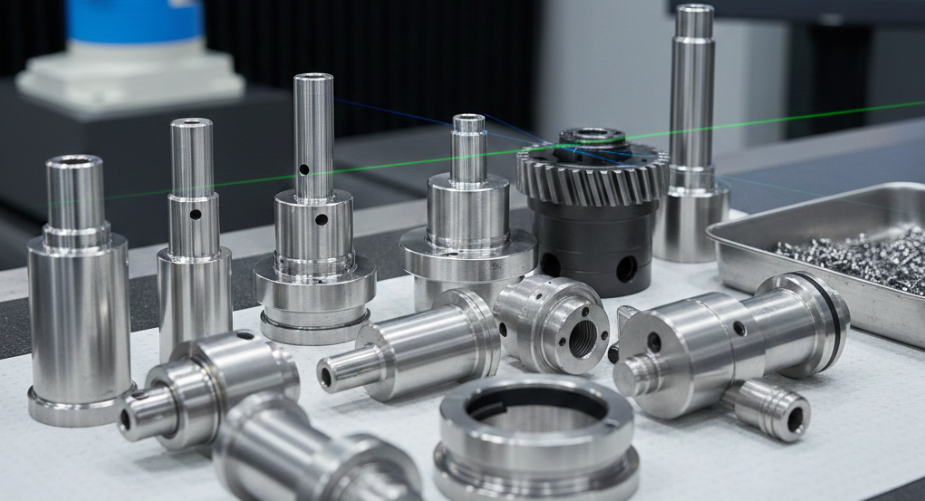
Nowadays, the manufacturing industry is very demanding and only the components with the highest accuracy, quickest production time, and the best quality will be accepted from the suppliers. Precision CNC machining is responsible for making the intricate parts that are used in various domains aerospace, automotive, medical, defense, and electronics. The traditional manual machining methods, however, succumbed to increasing demand for higher performance. At this point, automation and robotics have made a big change in the production area and have given better precision, repeatability, and efficiency. The integration of automated systems with CNC machines grants the manufacturers to achieve lights-out production, less mistakes, and better workflows. Having an advanced precision CNC parts supplier that uses automation as a partner means higher productivity, consistent tolerances, and reliable delivery at scale.
What are Clarity CNC, such as Parts, and Why Do They Matter?
Precision CNC parts are items that are produced with the assistance of Computer Numerical Control machines to achieve very accurate dimensions and complicated shapes which are necessary for advanced industries. They give excellent fit, function, durability, and performance, thus enabling mission-critical applications where even a slight change can affect safety or efficiency.
These parts are fewer portant as they allow the following to happen:
- Performance that can be trusted even in extreme conditions like those found in the aerospace and defense industries.
- Very tight tolerances and repeatability for the medical and automotive industries.
- The production of complicated shapes that are not possible with manual machining.
- Lower product failure risk and increased operational reliability.
- The rapidity o,f the innovation cycle and the increase in production scalability in collaboration with a reliable precision CNC parts supplier.
Key Challenges in Traditional CNC Machining Without Automation
The conventional CNC machining process is dependent on manual operations to a large extent which raises the likelihood of inconsistencies and inefficiencies. Human involvement usually reduces speed, accuracy, and repeatability, particularly when it comes to large production volumes and complex part geometries.
Some of the main challenges that are encountered are as follows:
- Setup and handling of parts are prone to more human errors.
- Production output is slowed down, and cycle times are extended.
- Labor dependence is increased, and operator fatigue is a problem.
- It is hard to keep tolerances consistent in multiple batches.
- The cost of the process is escalated by scrap, rework, and quality issues.
How Automation and Roboticss Transform CNC Production?
Automation and robotics are machining disruptors, and CNC machining is one of the processes that has greatly benefited from these machinery changes. Using integrated robotic systems, tedious operations are performed, thus making production lines more productive and uniform quality-wise.
The main advantages of these changes are the following:
- Automated operations for part loading, unloading, and tool management.
- Process control in real-time has the least manual interference.
- Lights-out production capability with unceasing machining.
- Smarter control through integration with CAD/CAM software.
- Two-way communication between producers and consumers through improved scalability with small and large batch requirements.
Improved Accuracy and Dimensional Precision Through Automation
Automation brings about an unprecedented level of control over the machining process, thereby reducing variability to a large extent and meeting the requirements for exactly specified outputs every time. Without the influence of the operator, smart systems are able to observe tool performance, cutting parameters, and dimensional output.
Advantages of precision enhancement:
- consistently obtained results with very small deviations from design tolerances.
- systems for automated measurement that conduct inspection and correction in real time.
- less scrap and rework due to adjustments based on predictions.
- machining conditions that are always stable even when complex materials and micro-features are involved.
- Higher alignment and positioning accuracy due to the use of robots for handling.
Enhanced Productivity and Cycle Time Reduction
Automation works wonders on reducing production times dramaticanoosting the output of machines by its capability to make the machines available at their maximum and also by consistently reducing the time they stay idle.
There are several ways in which the productivity System enhanced:
- Shorter cycle times and less time to wait for high-volume orders.
- Machining without any downtime even at night, with lights turneMachining/7.
- Non-stop flow of work in the production area with no waiting time between machining steps.
- Increased capability to take orders and also better use of resources.
- Stable production with a performance level not affected by fewer disruptions.
Robotic Machine Tending: Reducing Manual Intervention
The robotic machine tending system takes over the loading, unloading, and rotating of parts, thereby removing monotone human labor and enhancing safety in the working environment.
Some of the advantages are:
- Less tiredness of the workers and less reliance on labor.
- Quicker changes between production cycles, fewer.
- Uniform part handling with no harm caused.
- Better work ergonomics and less risky environments.
- Highest possible CNC machine working time plus efficiency in producing throughput.
Data-Managed Smart CNC Machining and Real-Time Monitoring
Through the application of IoT sensors, analytics, and cloud monitoring, Smart CNC systems have managed to keep accuracy of machining and performance of the whole equipment at their optimum level.
These capabilities are powered by data:
- Modification of cutting parameters through AI.
- Quality control reports are automatically produced.
- Fewer unanticipated delays and less waste in production.
Regularity, Stability & Quality Control at Scale
The performance of Automated CNC systems remains the same, no matter if they are used for hundreds or thousands of parts, thus making them a reliable option for volume manufacturing.
Quality control advantages:
- Uniformity of the output in every production cycle.
- Usage of automated measurement and laser inspection systems.
- Process standardization through statistical process control.
- Greater certification compliance for the industries with strict regulations.
Cost Efficiency and Labor Optimization
Costs associated with automation are significant at the beginning, but they are really worth it in the long run, as the production costs are lower to a great extent and the making of profit is much higher.
The list of benefits that cost-saving includes is as follows:
- Lower salaries and reduced wastage of materials.
- Better functioning and longer life of machines.
- No or very little stoppage and using materials in a better way.
- More quantity and quality of work done per worker by hiring expert people.
Automation in Precision Industries
CNC machining powered by automation is the technique that is most preferred for the industries requiring very strict tolerances and reliability to the max.
Common industry applications:
- Aerospace: blades of the turbine, assemblies of structure, parts of landing gear.
- Medical: instruments for surgery, implants, and components for robotic surgery.
- Automotive: blocks of the engine, parts of transmission, components for electric mobility.
- Electronics: houses for semiconductor, connectors, parts of micro-machining.
How to Select the Right Clarity CNC Parts Supplier?
Choosing a skilled precision CNC parts supplier is the right step towards high quality, on-time delivery, and good prices.
The main criteria for selection are as follows:
- The fusion of robots and computer numerical control machining systems that are fully automated and connected.
- Certifications (ISO, AS9100, IATF16949, medical standards acceptance).
- A system that allows for instantaneous quality valuation and documentation.
Future of Precision CNC Part Production with Robotics & AI
Autonomous machining will be the norm in the future, wsemiconductorsep in the produand ction will be controlled through AI, robots, and intelligent analytics.
The following are the predictions for the future:
- Complete automation through high-quality integrated robotic cells.
- Machining optimization and process simulation based on AI.
- Predictive accuracy through the application of digital twin techniques
- Manufacturing without defects along with the incorporation of automatic corrective systems.
Conclusion
The manufacturing sector is going through a transformation powered by automation and robotics as they have brought about the following benefits: enhanced precision, quicker production, and uniform quality for intricate components. In order not to lose their market share, the manufacturers have to team up with a precision CNC parts supplier that is technologically advanced and capable of performing automated production, smart monitoring, and high-volume, scalable production simultaneously. The CNC machining technologies of the future are in their entirety automated digital factories that provide precision, reliabilit,y and production cost reduction in every sector of the market.
FAQs
1. How do robotics improve CNC machining accuracy and repeatability?
Robotics remove human error, stabilize the workflow and give the same precision for all the production cycles by maintaining the same tolerances.
2. Does CNC automation lead to a cost reduction for the production of complex parts?
CNC automation greatly decreases the total production cost due to the reduction of scrap, labor expense, and cycle time.
3. What industries are the most benefited from precision CNC automated makers?
Aerospace, automotive, medical, defense and electronics industries are the ones that benefited the most from the clarity machining done by the robotic process.
4. How do I evaluate if a precision CNC parts supplier uses advanced automation systems to stabilize the integration, including the robot certifications, inspection technology, production capability, real-time monitoring, and automated quality control systems?
5. Can automation help achieve faster delivery timelines for large production orders?
Yes, automation increases the production rate, allows non-stop manufacturing, and eventually shorter delivery timelines.