
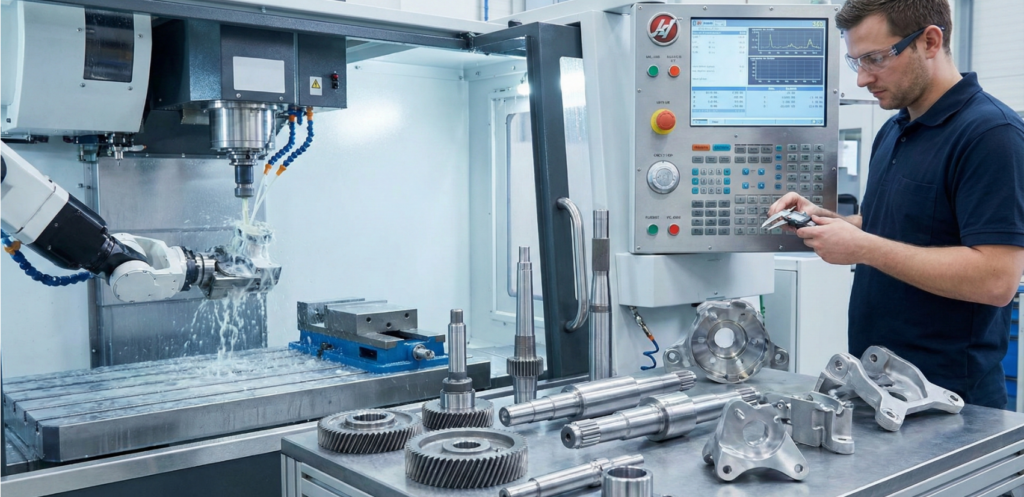
The aerospace industry is susceptible to errors, as even the tiniest mistake can cause a critical failure of the whole system. Thus, every part of airliners, satellites, and spacecraft has to be strictly within the prescribed limits to guarantee performance, safety, and longevity. It is for this reason that aerospace production is so reliant on precision CNC-machined parts, which offer the highest accuracy, repeatability, and reliability. This remarkable precision in all created parts is achieved through the most modern computer-controlled machining technology that can handle even complex geometries and the most difficult materials like titanium, aluminum, and Inconel. As aerospace engineering keeps on innovating, precision CNC machining parts will continue to be a crucial support for advanced engineering and a guarantee for worldwide safety standards.
What are Clarity CNC Machining Parts?
Precision CNC machining parts are, by definition, parts that are manufactured by a precision CNC machine that can achieve even the most complex details with an extremely high level of precision and reproducibility. These parts have tolerances of up to one micron, thus ensuring their stability and long-term use. This is very important in the aerospace sector, where safety is the utmost priority.
Main characteristics are:
- Very narrow tolerances and great dimensional precision
- Superb repeatability leading to uniform results
- Possibility to shape 3D structures of high complexity
- Compatibility with tough materials that are utilized in the production of aircraft and space systems
Why the Aerospace Industry Demands Extreme Clarity
The aerospace industry operates with a zero-tolerance mentality, which implies that all the parts used have to work perfectly, even under the most extreme environmental conditions. The precision CNC machining parts play a very important role in ensuring that the aircraft is reliable, safe, and compliant with the regulations.
Several factors make ultra-precision a must in the aerospace sector:
- Even a tiny dimensional mistake may lead to disastrous accidents.
- The performance depends upon the weight, fit, and alignment
- Parts are subjected to vibration, high pressure, and temperature extremes
- The critical components need to be perfectly compatible itowork together without any problems
The Parts of High-Precision CNC Machining in Aerospace
High-precision CNC machining is crucial for manufacturing structural and engine components of both aircraft and spacecraft. The quality and consistency of CNC machining are maintained throughout the process, from prototyping to mass production.
The major contributions to this are:
- Production of thin-wall and complex structural components
- Fabrication of long-lasting engine and turbine parts
- Manufacturing lightweight interiors that are still strong
- Fast tracking of prototype and spare parts development.
Makers Used in Aerospace CNC Machining
The aerospace industry needs high-tech stuff capable of surviving extreme heat, pressure, and rust. Precision CNC cutting and milling are used to process special metals and plastic materials for aircraft manufacturing.
Some of the materials that are frequently used are:
- Titanium alloys – Super strong with low density and very gives ga great advantage in weight.
- Aluminum is a metal with very low weight and is also corrosion-resistant.
- Inconel and nickel alloys have Excellent high-temperature performance.
- Stainless steel has of long life and maintains its stability at high temperatures as well.
- Carbon fiber composites are super strong and super light as well.
CNC Machining Capabilities Essential for Aerospace
The aerospace industry demands quite advanced CNC abilities for the machining of very intricate and precise parts. Such abilities guarantee the three factors: productivity, performance, and reliability for a long time.
Main machining capacities are:
- CNC 5-axis and multi-axis milling for very detailed shapes
- Turning with the highest precision for circular and cylindrical items
- Prototyping was done quickly to check the design.
- Production with high repeatability for the same quality
- Compatibility with advanced surface finishing and coating
Applications of Precision CNC Machining Parts in Aerospace
The precision CNC machining parts find their way into almost every part of an aircraft, including engines and cabin interiors.
Applications in the aerospace sector:
- Parts of engines and turbines
- Mechanisms, hydraulic systems, and the landing gear
- Housings for avionics and cockpit instruments
- Components and fittings for fuel systems
- Brackets for frames and structures
- Components for satellites and rockets
Benefits of High-Precision CNC parts for Aerospace
The aerospace industry was able to take a big step forward thanks to high-precision CNC manufacturing, which brought performance, efficiency, and cost advantages.
Main points:
- Reduction of component weight leading to better fuel consumption
- Aircraft performance and reliability are up
- Precision tolerances contributing to safety
- Decreased lifecycle and maintenance costs
- More productivity, along with quicker turnaround time
CNC Machining and Aerospace Quality Standards
The aerospace sector imposes the most rigorous global certification standards for safety and reliability reasons. Precise CNC machining parts manufacturers are compelled to go through quality and inspection processes that are regulated.
The major standards of the industry are as follows:
- Conformity with AS9100 and ISO 9001 certifications
- CMM inspection and digital measurement
- Verification through CAD/CAM and simulation-based techniques
- Traceability and documentation for every production stage
Growth in CNC Technology Driving Aerospace Innovation
With the help of automation and digital technologies that enhance accuracy, productivity, and speed. Modern CNC machines are revolutionizing the aerospace industry.
The most recent innovations are:
- Machining systems with 5 and 7 axes
- Digital twins and machining based on simulation
- AI-supported optimization of tool paths
- Robotics and smart manufacturing that are automated
- Additive and subtractive machining methods that are hybrid
Challenges in Manufacturing Aerospace CNC Components
The manufacturing complexity of producing aerospace components necessitates the combination of skill, advanced equipment, and strict procedure regulation.
Some of the main difficulties are:
- The use of heat-resistant and difficult-to-machine materials
- Maintaining very close tolerances in the production of thin-wall parts
- The requirement of wide-ranging inspections
- The long duration of production, coupled with the high cost of mistakes
- The imposition of very stringent certification and documentation standards
CNC Machining vs. Other Manufacturing Processes for Aerospace
Producing aerospace parts involves a great deal of skill, high-tech equipment, and total process control due to the complexity of manufacturing.
The most important difficulties are:
- Dealing with very tough materials that are both resistant to heat and difficult to cut
- Keeping very precise dimensions in hollow parts
- Carrying out inspections on a large scale
- Slow production rates and expensive mistakes
- Imposing certification and paperwork requirements
Future of Precision CNC Machining in the Aerospace Industry
The future of aerospace manufacturing is going to be determined by three main factors: automation, advanced materials, and hybrid manufacturing. The accuracy of precision CNC machining will still be a main factor in the development of aeroplanes with lighter structures and better performance.
Future trends:
- More frequent deployment of automated intelligent factories
- Combined use of CNC and additive manufacturing technologies
- Demand for aircraft and space parts with electric propulsion is increasing
- AI-based forecasting for machining and controlling processes.
Conclusion
The segment of the aerospace industry relies heavily on precision CNC machining parts for those parts that give reliability, accuracy, and performance that are up to a point of safe flight operations, consistently. The ability of CNC machining to manufacture complex geometries, work with progressive materials, and pass through rigorous certification standards makes it a very important process in the making of modern aircraft and spacecraft. And if technology continues to advance, it is going to be just like that – precision parts made from CNC machining will be the one thing that brings about change, will be the one that keeps on bringing safety, and will be the one that supports the world’s aerospace development.
FAQs
- Why is precision machining critical in aerospace manufacturing?
Precision machining is basically the main reason why aircraft can be so accurate, safe, and reliable, even if they are used in extreme environments.
- What are the tolerances of aerospace precision CNC machining parts?
The tolerances of the parts of the aerospace are generally about 0.002 mm, which is the degree that provides the perfect fitting and functioning of the parts.
- What materials are most frequently machined for the production of aerospace parts?
Some of the top machinable materials for the aerospace industry include. Titanium, aluminium, pure iron, Inconel, and carbon fiber blends.
- How does CNC machining support aircraft technology and safety?
The use of precision CNC machining for making aircraft parts not only fulfills but also exceeds the needs of the lighter, stronger, and stable structure with reliable flight performance.
- Is CNC machining a method that can be used both during prototyping and large-scale aerospace production?
CNC machinery operations are just as relevant in the quick prototyping stage as they are in thorough testing and large-scale production with excellent repeatability.