
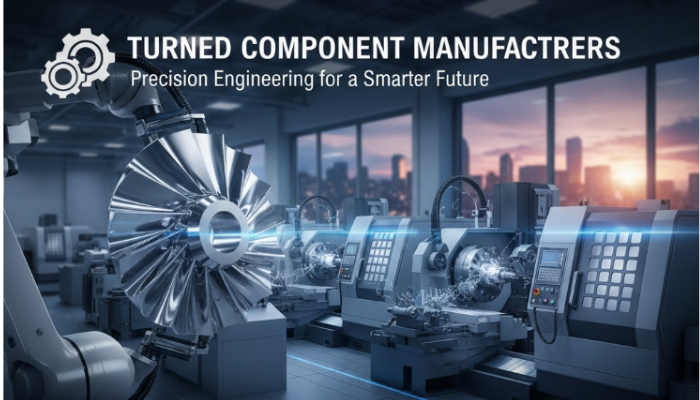
The companies that are competitive in today’s manufacturing world usually get their turned component manufacturers to supply them with parts that have been precisely engineered. These parts are used in different industries, such as automotive, aerospace and electronics, so they have to be of the best quality. On the one hand, working with a local turned component manufacturer could bring you a faster lead time but also a higher cost; on the other hand, an overseas one might give you a longer lead time but at a lower cost plus possibly lower quality in your parts. Each alternative has its own benefits and drawbacks that depend on production targets, logistics, and financial ideas, respectively.
Once you grasp these nuances, it becomes easier for companies to take steps that not only speed up but also maintain the long-term reliability of their operations. The article outlines the pros, cons, and costs related to local as well as overseas turned component manufacturers with an aim at facilitating the right partnership choice for your business.
What Are Turned Components?
Turned components are the parts made of metal or plastic, and they are produced by CNC (Computer Numerical Control) and automatic turning processes. These parts are used in making the products of the industries, such as automotive, aircraft, medical, and electronics, where accuracy and uniformity are super important. The turning operation rotates the material bar while the tool cuts it to the desired shape. This guarantees very close mercies and a good surface finish.
Parts that are precisely made for machinery and devices of very high performance.
It is possible to adapt to sizes and use materials like steel, aluminum, brass, or plastic.
Best for making cylindrical forms, shafts, and joining pieces.
Designed for repeatability and consistency across large production runs.
Essential for sectors demanding durability, reliability, and dimensional accuracy.
Understanding the Two Options: Local vs. Overseas Manufacturing
The Companies that are sourcing turned components usually encounter the decision between local and overseas manufacturing. The two options have their own unique benefits, which vary according to different factors like cost, speed, and scale.
The major differences are as follows:
Local turned component manufacturers are in the same country as the buyer, which means they are close to the buyer, communication is easy, and the delivery time is short.
Overseas turned component manufacturers are located in another country, which gives them the ability to access the whole world’s resources, and they can cut down production costs considerably, and are capable of producing in bulk.
Local sourcing aids regional industries and provides faster reaction times.
Key Benefits of Working with a Local Turned Component Manufacturer
The local turned component manufacturers’ collaboration grants numerous advantages, which magnify the operational productivity and quality assurance. The fast delivery and reliability of local partnerships often become the priority for companies sourcing manufacturers.
The principal benefits that come out of it are:
Communication is faster: The collaboration benefits from the alignment of the time zones and the familiarity with the languages.
Lead times are shorter: The geographical distance between the parties involved in the process is a factor that guarantees not only quicker but also shorter delivery cycles.
Quality inspection is easy: Regular on-site visits and audits can be performed by the clients.
Order management is flexible: Small batch orders or urgent requirements are easier to accommodate.
After-sales support is better: The maintenance and adjustments needed can be addressed quickly by the local teams.
Trust and accountability are enhanced: Better transparency and mutual understanding are the result of close relationships.
Benefits of Selecting an Overseas Turned Component Manufacturer
An overseas component manufacturer brings significant financial and production advantages to numerous companies. Besides these, such suppliers also come with advanced facilities and large-scale production capacities.
Some advantages are as follows:
Due to the presence of inexpensive labor and the availability of materials, production costs are lower.
Large-scale manufacturing capacity is opened up for large-scale projects.
A variety of materials can be obtained from global supply chains.
High-level skills are available in the production of complex turned components.
Cost Comparison: Local vs. Overseas
The disparity in cost between local and overseas turned component manufacturers is not limited to just the production rates. Factoring in logistics, taxes, and time considerations, businesses have to consider the overall expenses.
Some of the cost factors are:
Production cost: Generally, overseas options are lower due to the cheap labor costs.
Shipping and duties: Using local sources means that there are no import taxes and freight costs associated with long-distance transportation.
Lead time cost: The global shipping delays can have a negative impact on the company’s inventory and production schedules.
Quality control cost: Inspections are easier in the local setting, whereas in the overseas setting, they may involve travel or the use of third-party agencies.
Order flexibility: Local manufacturers will take up smaller orders without imposing heavy surcharges.
Quality & Compliance Considerations
The selection of a turned component manufacturer will always entail the process of quality assurance, which is the most important aspect. Precision will be maintained, and adherence to international standards will be guaranteed. Thus, ensuring the long-term reliability and safety of products.
Points to consider:
Certification standards: Look for ISO and specific industry approvals.
Material traceability: Make sure that all raw materials are tested and documented.
Inspection procedures: Look for quality controls at every stage and strong final checks as well.
Regulatory alignment: It might be easier for local producers to comply with the laws of the region.
Supplier transparency: Go for the partners who have clear reporting and performance data as one of their offerings.
Impact on Supply Chain & Logistics
The reliability of the supply chain has a direct impact on the production’s efficiency. If the manufacturer of components is either local or overseas, logistics, along with the delivery schedule, should be calculated very meticulously.
Logistics factors consist of:
Delivery timelines: Suppliers located nearby offer quicker and less uncertain deliveries.
Risk management: International shipping could encounter customs or port disturbance, which could delay the shipment.
Inventory management: The local plants are in a position to follow just-in-time inventory techniques.
Shipping & handling costs: Companies sourcing locally save on freight charges.
Crisis adaptability: Local producers can leap during the global disruptions and inconveniences.
Hidden Costs to Consider
At first glance, sourcing from abroad might seem like a cheaper option; nevertheless, a number of hidden costs can put a dent in the total expense of turned component manufacturing.
The most common hidden costs are:
Import duties and tariffs are included in the landed cost.
Currency fluctuations are long-term pricing stability issues.
Long lead times need to be considered for production downtime or delayed deliveries.
Quality variations that result in inspection and rework expenses.
Miscommunication caused by language differences, resulting in misunderstanding or even design errors.
Stability and Environmental Impact
The environmental impact of turned component manufacturers will be a decisive factor in the selection of manufacturing processes as the industry continues to prioritize sustainability. In many cases, the use of locally produced raw materials fits better with the green goals.
Sustainability options are:
Less carbon emissions owing to on-site production and quick transport.
Lower packaging waste because of local deliveries.
Energy-efficient facilities operating within environmental standards.
Support for a circular economy by working together with nearby recyclers.
Corporate responsibility: Local sourcing is a method for making sure the community develops in an environmentally friendly manner.
Overseas shipping emissions: The globalization of shipping leads to more than three times the CO2 emissions.
Choosing the Right Turned Component Manufacturer
It is not an easy task to select a turned component manufacturer. The customer will have to consider several aspects, such as cost, quality, and dependability. Based on a thorough evaluation, the supplier may already practice a long-term partnership with the customer.
Selection tips:
Verify the manufacturer’s technical capabilities and machine tools for both precision and large quantities.
Check out the certifications that prove the factory adheres to the required quality standards for its products.
Get prototypes or a small series of production to test before ordering in large quantities.
Communication and technical support should be evaluated regarding their efficiency and timing.
Get in touch with the manufacturer’s clients to obtain references that will give you an idea of the manufacturer’s reliability and performance.
When determining the manufacturer’s pricing, compare the overall cost of ownership rather than the single price only.
Conclusion
The decision between a local and an overseas turned component manufacturer is greatly influenced by factors such as cost, quality, and delivery time. Both alternatives have their own merits, which, when recognized, lead to improved decision-making. Turned component manufacturers are reliable no matter what, be it small-batch precision or large-scale production, and they deliver accurate, consistent, and valuable products. It is vital to select the right partner for long-term success,s that depends on a steady supply for your manufacturing needs.