
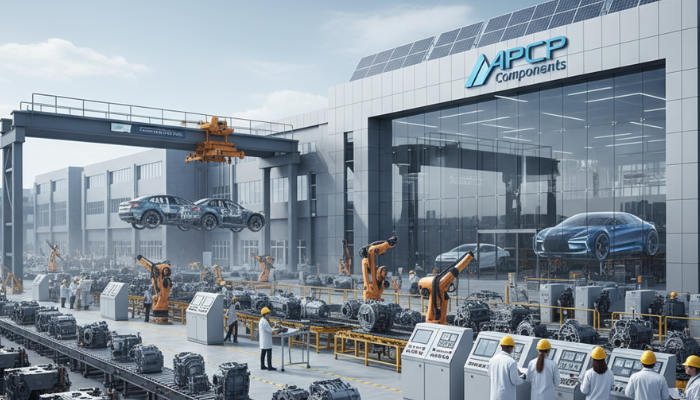
In the current rapidly changing automotive industry, the function of a high-quality car part supplier has become extremely important. The performance, safety, and lifetime of a vehicle are all determined by the precision-engineered components; therefore, quality manufacturing is the foundation of the whole industry. Great producers use everything from advanced materials to high-tech production methods to make sure that every part complies with the highest global standards. The top automobile component manufacturers are leading the way in technology, quality control, and customer-focused engineering solutions that empower the next generation of cars across the globe by being the most innovative and sustainable partners in the industry.
The Backbone of the Automotive Industry
The global automotive market is based on innovation, reliability, and precision — and all these become possible through the skilled labor of a competent automobile component manufacturer. Manufacturers of auto parts are the pillars of the modern vehicle production process, and they are the ones who make sure that every single part works perfectly in complex systems. Their influence is not only limited to the production lines but also reaches the global supply chains and the evolution of technology.
The main activities of the automobile component manufacturers:
Make it possible to produce automotive components that have high performance and are durable consistently.
Give Original Equipment Manufacturers (OEMs) a steady and timely supply of parts.
Help in making cars safe, efficient, and economical in terms of fuel consumption.
Add automation and smart manufacturing processes for more productivity.
Innovation is fostered through design, testing, and advanced engineering solutions.
Core Qualities of a Top Automobile Component Manufacturer
A premier supplier of automotive parts is known for an impeccable mix of technology, quality, and dependability. They produce not only the parts but also provide the clients with near-perfect technical precision and flexibility.
Core qualities comprise:
Technical expertise: Thorough understanding of automobile systems and production technologies.
Quality ensure: Each step of the maker process is subjected to strong testing to ensure uniformity of results.
Advanced machinery: Accuracy is attained through the use of CNC, robotics, and automation.
Compliance and certifications: The company clings to the international automotive quality standards like ISO and IATF.
Innovation-driven mindset: The vehicle technologies are changing, and so is the company’s progress and adaptation.
Precision Engineering and Advanced Technology
Precision engineering is the hallmark of the automobile component manufacturer’s quality. Advanced technology, with its ability to deliver the accuracy and reliability required by the global market, is the go-to method in modern automobiles that demand exact specifications.
Technological breakthroughs consist of:
CNC and 3D printing modeling for precise design and part making in the manufacturing process.
Collaboration between CAD and CAM for streamlining production processes and minimizing the chances of mistakes made by operators.
Use of machines and robots for uniformity in the quality of the final product.
Artificially intelligent inspection systems that make sure no defect reaches the end of the production line.
Installation of equipment and practices based on data for higher productivity and predicting maintenance needs.
Commitment to Quality and Global Standards
It is the quality control and global compliance that are the very characteristics of all the topmost automobile component manufacturers. Quality assurance is not merely a procedure made and then forgotten; it is a culture that is ingrained in every level of manufacturing.
The quality commitment comprises:
You have been certified for ISO 9001 and IATF 16949, which are recognized globally as the only standards.
Multi-stage quality assurance systems that commence with the selection of the raw materials and conclude with the final assembly.
Quality monitoring through the use of traceability systems that cover the entire supply chain.
Statistical process control (SPC) is a tool for ensuring precision and dependability.
Quality aspects were taken from the customer side that secured the OEM’s contentment and a lasting bond of trust.
Material Selection and Procurement Policies of the Highest Quality
The choice of the material is a major factor in the product’s life cycle, performance, and ecological impact. An automobile component manufacturer of good repute always goes for the best and the greenest materials that can stand the rigors of the automotive world.
Significant material practices and sourcing stances:
Raw materials that are certified, like high-strength alloys and composites.
Raw materials are sourced ethically in compliance with global standards.
Stringent supplier audits to ensure quality and reliability.
Material testing and validation for endurance over time.
The use of light materials in the design resulted in better fuel efficiency and performance.
Innovation and R&D: The Road to the Future
Continuous innovation is the major factor that differentiates a top automobile component manufacturer from the others. R&D contributes positively to all phases of design, performance, and sustainability by making sure that the company is capable of handling the forthcoming challenges of the automotive industry.
Among the key innovation areas are:
Development of components for electric vehicles (EVs) is necessary as the EV segment is growing.
Use of lightweight and durable materials that will help minimize carbon emissions.
Application of smart sensors and IoT-enabled systems to enable connected mobility.
Digital prototyping and simulation testing are being used to speed up the process of innovation.
Joint R&D programs that are taking place along the OEM technology roadmaps.
Sustainable Manufacturing and Eco-Friendly Practices
Sustainability comes first in the list of priorities for the modern automobile component manufacturer. Eco-friendly manufacturing helps to lessen the impact on the environment, and at the same time, it contributes to a cleaner future for the automotive industry.
Sustainability practices consist of:
Using up renewable resources by means of energy-saving production systems.
Having a comprehensive program for waste reduction and recycling at every level of the plant.
Controlling emissions in conjunction with environmental regulations.
Water preservation in the production process.
By means of techniques and materials for packaging and transport that are totally eco-friendly and have a minimal carbon footprint as a result.
Effectiveness of Supply Chain & Global Access
Effective logistics and supply chain management are the fundamental support for reputable automobile parts manufacturers to assure quality delivery and keep customers happy. Strongly built connections bring goods to global markets without delay.
The strengths of the supply chain can be summarized as follows:
Real-time order tracking by integrating ERP systems.
Minimizing downtime and inventory costs through predictive logistics planning.
Building trust through collaborative vendor relationships.
Enhancing transparency with digital documentation and tracking.
Providing timely delivery across continents with global distribution networks.
Customization on Demand and OEM Collaborations
A customer-centric automobile component manufacturer whose main traits are flexibility and customization. The partnership with OEMs leads to the creation of new components that are customized according to the vehicle’s aesthetic and functional requirements.
Some benefits of the partnership are:
- Co-design and joint prototyping for the development of new products.
- Custom-engineered solutions created according to the specific OEM needs.
- Quick prototyping and testing to have a shorter time-to-market.
- Technical consultancy and support during the entire making phase.
- Long-term strategic alliances that are indicative of continuous improvement and trust.
Comparing Top-Tier and Average Manufacturers
High-class automobile parts manufacturers always show superiority in the fields of technology, quality, and innovation, contrary to low-class manufacturers who usually suffer from the incapability issue, along with inconsistency.
Although the high-class businesses put precision engineering, worldwide compliance, and sustainable development on top of their priority list, the others may use old ways of working and vary in quality.
Their accomplishments are characterized by:
Complying with worldwide quality norms and getting certified accordingly.
Investing heavily in R and D, robotic process automation, and intelligent manufacturing.
Competent to supply at all times, thanks to the advanced supply chain logistics.
OEMs have been partnering with each other for a long time, and as a result. They have been able to produce more innovations together.
Being eco-friendly in working and matching the company’s stability aim.
Conclusion
Selecting the proper automobile component manufacturer is of utmost importance in maintaining safety, performance, and reliability. The manufacturers of the highest quality bring together precision engineering, quality control, and innovation to fulfill the requirements of the worldwide market. They are the ones who pull the whole automotive industry towards excellence with their innovative technology and eco-friendly practices. The collaboration with a reputable maker provides the customer with a long-term benefit, excellent parts, and successful coexistence in the midst of cutthroat competition.